
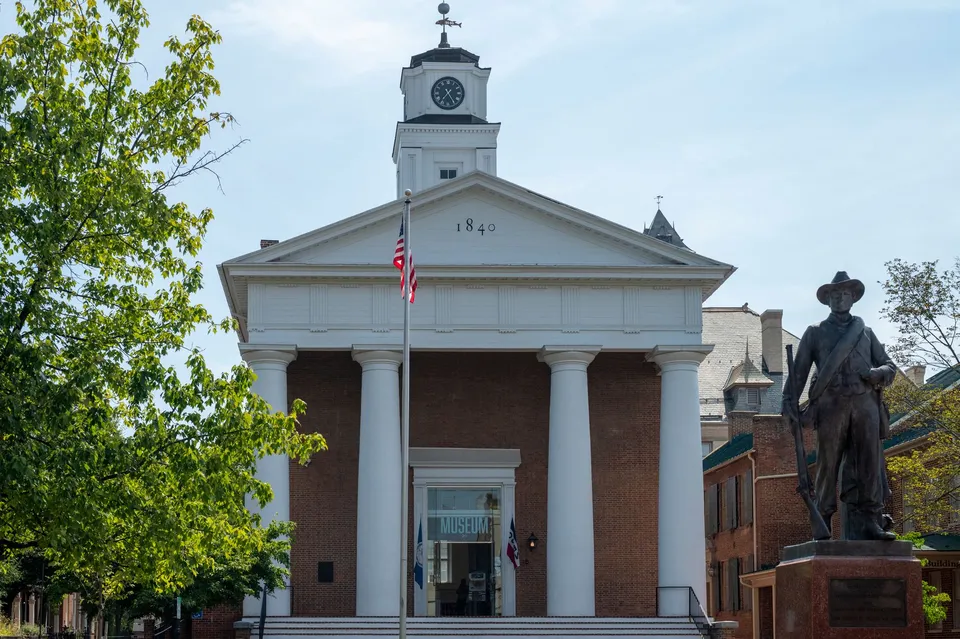
Park Rapids is small enough that a new visitor can get oriented quickly, but that does not mean the town feels simple. In fact, some of its most important places are the ones that quietly explain how the community became the county seat and why it still feels like a working center for Hubbard County. The courthouse, the local newspaper, the historical museum, and even a prehistoric site all tell different chapters of the same story, and together they make Park Rapids easier to understand. Hubbard County was established in 1883, and the county seat was set at Park Rapids at the first meeting of the county commissioners, which anchored the city as the administrative center for a largely rural county. The same National Register record notes that county offices were first in rented quarters, then in a county building erected by Todd Township, and later in the courthouse built in 1900 on land donated by Cyrus Hollinger.
That history matters because it explains why Park Rapids has never been just a scenic stop on the way to somewhere else. County seats collect functions. They attract records, meetings, elections, repairs, and the ordinary paperwork of daily life. In Park Rapids, that civic role is still visible in the courthouse complex and in the institutions around it. The courthouse is not simply an old building; it is one of the places where the town’s public memory stays organized. When people talk about Park Rapids as a hub, this is part of what they mean: the town carries county responsibility, not just downtown traffic.
The strongest proof that Park Rapids keeps its past in motion may be the local newspaper. The Minnesota Historical Society shows that the Park Rapids Enterprise began in 1882, became the Hubbard County Enterprise in 1883, and resumed publication as the Park Rapids Enterprise in 1954; it is still publishing. That continuity gives the town something many small places lose over time: a running public record. Births, celebrations, sports, city debates, business changes, and school milestones do not disappear into memory here. They are stacked in print, issue after issue, so the town can look back without relying only on nostalgia or family stories.
For newcomers, that matters in a very practical way. A town with a long newspaper history usually has a stronger sense of what counts as local, what counts as change, and what counts as a repeat of an old question in new clothes. That makes Park Rapids easier to enter and harder to misunderstand. If you want to know what people have cared about here for generations, the paper offers one answer; if you want to know what still needs attention, it offers another. The newspaper is not just a souvenir of civic life. It is part of the machinery that keeps civic life legible.
The Hubbard County Historical Museum adds another layer. The Minnesota Historical Society directory lists the museum at 301 Court Avenue in Park Rapids. That address is fitting. It places local history close to the seat of county government, which reinforces the idea that memory and administration are not separate worlds here. The museum helps explain the town, but it also helps explain the county around it. In a region where townships, lake properties, rural roads, and small communities all shape daily life, a museum is more than a display room. It is a place where scattered stories become easier to compare.
Park Rapids’ past is also older than the county seat era. The Shell River Prehistoric Village and Mound District in Hubbard County is listed in the National Register as a prehistoric and historic-aboriginal district. That reminder is important because it keeps the modern town from swallowing the deeper landscape around it. Park Rapids did not begin with a courthouse, a newspaper, or a numbered street grid. Those are later layers. The older layer is the land itself, which has carried people and meaning long before the city limits existed.
This wider timeline changes how the town feels when you walk through it. Court Avenue is not just a route to errands. It is a place where county government, preservation, and memory still overlap. Red Bridge Park and the Heartland Trail add another kind of connection, because they show that Park Rapids’ public spaces are not split between “history” and “recreation.” The city says Red Bridge Park sits on Beach Road, covers one acre, connects by the red bridge to Heartland Park, and serves as a trailhead for the Heartland Trail. In other words, one small park links daily movement, river access, and outdoor use.
That is what makes Park Rapids feel distinctive. Its history is not sealed behind glass. It is spread across a courthouse, a newspaper office, a museum, a river corridor, and county records that still shape how people live here. For residents, that creates a stronger sense of continuity. For visitors, it creates a better first impression than a simple “lake town” label ever could. And for someone thinking about settling in the area, it shows that Park Rapids is a place where the past still organizes the present in visible, useful ways.
If you want a good first look at that story, start on Court Avenue, then follow the river corridor to Red Bridge Park. In a town like Park Rapids, those two stops say a great deal without needing a tour.