
Park Rapids is easy to name and harder to read. On a map, it looks like a small county seat in north-central Minnesota. In daily life, though, it works more like a set of linked corridors: Court Avenue and the courthouse complex, Beach Road and the river park, downtown’s event blocks, and the county and city systems that move people, water, and information around town. That pattern helps explain why Park Rapids feels both compact and widely connected at the same time. Hubbard County set its county seat at Park Rapids in 1883, and the courthouse that followed still anchors the civic center today, while the city’s own website and chamber materials point residents toward shared regional services rather than a single all-purpose downtown building.
Downtown is a stage, not just a shopping strip
Park Rapids’ downtown matters because it does several jobs at once. The chamber describes it as a place for shopping, food and beverage, festivals, and a historic main-street feel, and its event coverage points to recurring programming such as the 2nd Street Stage. That matters because the downtown is not merely where errands happen; it is also where the community gathers, hears music, and sees itself in public.
The city’s own site reinforces the same idea in a quieter way. Instead of presenting every service as a city-run silo, it routes residents to KRLS for library access and points to community education and school information as shared resources. That small detail reveals a bigger truth about life in Park Rapids: some of the most useful public services are regional by design, not neatly contained within one municipal department.
For a newcomer, that is a useful mental shift. Park Rapids is not a place where everything funnels through one block. It is a place where downtown, schools, library services, and county offices each handle a piece of daily life. The result is a community that feels small enough to know but layered enough to require a little orientation.
Court Avenue holds the town’s memory
If downtown shows how Park Rapids functions now, the courthouse area shows how it became itself. The National Register history says Hubbard County was organized in 1883, the county seat was placed in Park Rapids at the first meeting of county commissioners, and county offices later moved into a courthouse built in 1900 on land donated by Cyrus Hollinger. That building remained the county headquarters until the mid-1970s. In other words, the courthouse is not decorative heritage; it is a long-running civic center that shaped where people did business, where records lived, and where county identity formed.
The memory layer continues a few doors away. The Minnesota Historical Society lists the Hubbard County Historical Museum at 301 Court Avenue in Park Rapids, which means the town’s official memory is not hidden in an archive far away. It sits in the same walkable civic corridor as the courthouse. That proximity matters because it turns history into something local people can actually visit, not just read about.
Park Rapids also has a rare continuity in its local press. The Park Rapids Enterprise dates back to 1882, became the Hubbard County Enterprise in 1883, and resumed publication as the Park Rapids Enterprise in 1954; it still publishes today. That long paper trail helps explain why local civic life feels so well documented. The town has been writing itself down for more than a century.
The river corridor is both park and passage
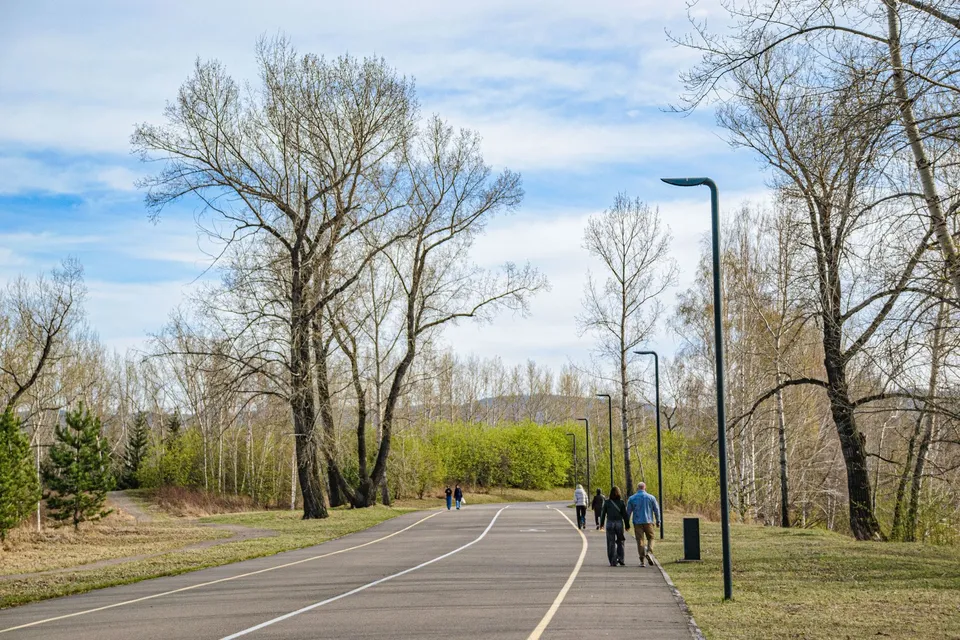
The most revealing public place in Park Rapids may be Red Bridge Park. The city says the park sits on Beach Road, covers one acre, connects by the red bridge to Heartland Park, and serves as a trailhead for the Heartland Trail. That makes the site much more than a patch of green space. It is where the Fish Hook River becomes a crossing point, a walking route, and a gateway into a larger trail system.
That larger system matters. County and chamber materials identify the Heartland Trail as a regional route that starts in Park Rapids and extends to Cass Lake, while the chamber’s outdoor pages place Park Rapids inside a broader trail-and-lakes landscape that includes the Lake Country Scenic Byway, the Crow Wing River State Water Trail, and Itasca State Park as a regional destination. The important distinction is that these places are connected to Park Rapids without being inside Park Rapids. The town is a node, not the whole network.
County recreation pages add another useful detail: Hubbard County maintains public boat accesses and beaches at several sites, including Heartland Park on the Fish Hook River and Garfield Lake near Laporte. That means the local recreation map is not limited to one city park or one lake. Everyday outdoor life here is spread across city parks, county access points, and trailheads.
The unseen systems are part of the story
A place like Park Rapids also depends on the infrastructure people rarely think about until they need it. The city reports 1,370 municipal water connections, 1,270 sewer connections, two water towers, five wells, and 16 lift stations. Those numbers do not create the town’s character by themselves, but they explain why city lots, public buildings, and nearby neighborhoods can function year-round in a county that also includes rural homes, lake properties, and seasonal places.
Transportation is another hidden layer. Heartland Express says it provides curb-to-curb service in Hubbard County, including Park Rapids and Bemidji, and it works with social services, veterans services, community education, Medicaid, and other partners. That is a practical mobility network, but it still requires checking routes and timing before relying on it. In a spread-out county, the existence of transit matters; so does the fact that it is not magic.
Why this view helps residents and visitors
Reading Park Rapids as a set of connected corridors makes ordinary decisions easier. If you want civic history, start at Court Avenue. If you want to understand daily community life, look at downtown events and the city’s shared-service links. If you want recreation, follow the red bridge toward Heartland Park and the Heartland Trail. If you need to get across town without driving, check Heartland Express first. Each place answers a different question, and together they describe a town that is smaller than a metro but more interconnected than it first appears.
A good next step is simple: take a walk from downtown to Red Bridge Park, then continue up Court Avenue to the museum. Those two stops show more about Park Rapids than a broad overview ever could.