
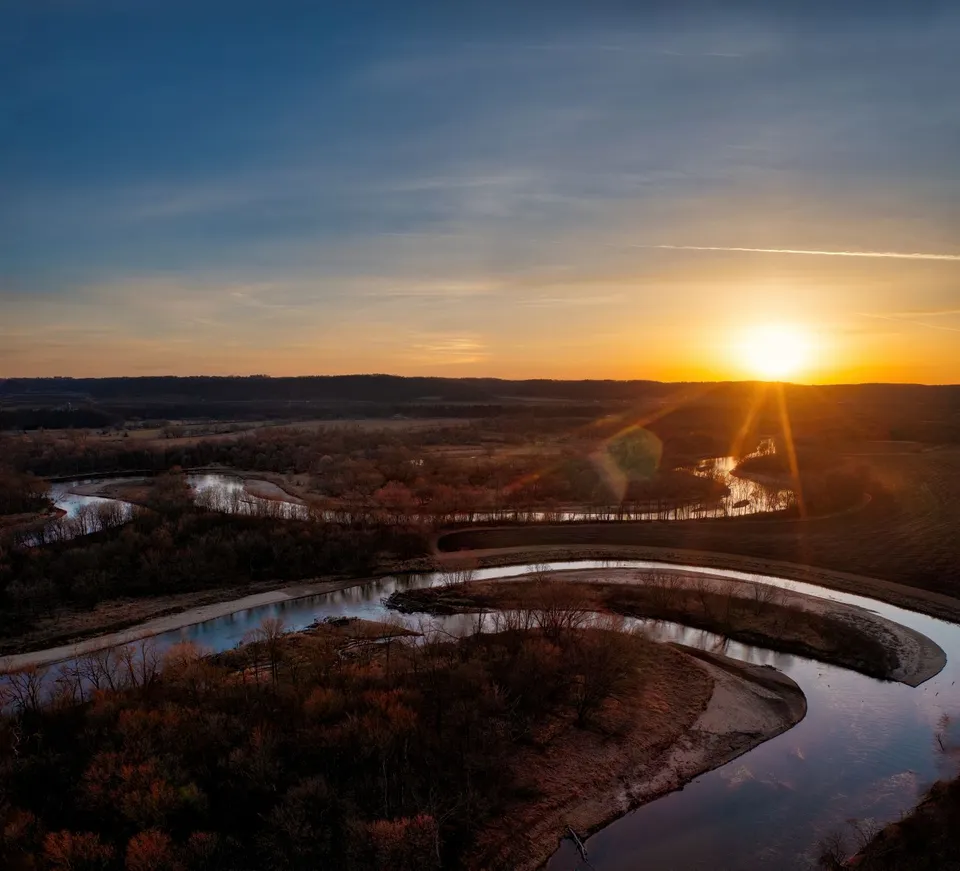
Park Rapids can look simple from a highway pass-through, but three public places tell a more accurate story: Red Bridge Park, the county transit system, and the municipal airport. Each one solves a different kind of distance. One helps people step from town to trail. One helps riders get around the city and out to Bemidji. One gives the area a small aviation base and a rentable civic room. Put them together, and Park Rapids stops looking like a place defined only by its downtown block or its lake season. It looks like a town that has built practical ways to move, meet, and keep going.
Red Bridge Park is a trailhead, not just a park
The city’s own parks information gives Red Bridge Park a surprisingly active job. It sits on Beach Road, covers just one acre, connects by the red bridge to Heartland Park, and serves as a trailhead for the Heartland Trail. That matters because it turns a small river park into a true hinge point: people can fish, walk, gather, or launch onto a longer route without needing a big destination park or a long drive first. In a town the size of Park Rapids, that kind of built-in connection is not decorative. It is part of how everyday recreation works.
The trail connection also puts the park into a larger regional pattern. Hubbard County’s recreational planning materials describe the Heartland Trail as starting in Park Rapids and extending to Cass Lake. The Heartland Lakes area chamber also places Park Rapids inside a broader trail-and-lakes system, where the Heartland Trail, the Lake Country Scenic Byway, and nearby parkland all overlap in the same travel map. That makes Red Bridge Park useful for more than a quick stop. It is one of the places where the city’s public realm opens outward into the region.
For residents, this is a good reminder that not every park has to be grand to be important. A small park can still carry a lot of civic weight when it connects neighborhoods, water, and trail access in one spot. For visitors, it can be the easiest place to understand that Park Rapids is not just a downtown or a resort area; it is also a place where public space is stitched directly into movement.
The bus matters because Park Rapids is a hub, not an island
Heartland Express fills a different role. It is not about leisure and it is not about a scenic stop. The service says it provides safe, reliable transportation for Hubbard County residents, offers curb-to-curb bus service to Park Rapids and Bemidji, and can get riders around the City of Park Rapids. It also says it works with Veterans Services, Community Education, the Development Achievement Center, Social Services, Medicaid, and others. That combination makes the bus system a practical part of local life, not a side note.
That also helps explain why Park Rapids functions the way it does. The city is the county seat, but the county is still rural enough that not every need sits on one block or in one neighborhood. A rider might need the city center for one appointment, a county office for another, and Bemidji for something else entirely. Heartland Express exists because those trips are real. The useful local fact is not that a bus replaces every car trip. It is that a county transit option exists at all, and it is tied directly to city and county services.
That distinction matters for newcomers, older residents, and employers alike. A town can have good services and still require planning. The bus network does not erase the need to check schedules, stops, or trip timing, but it does show that Park Rapids has built a mobility layer beyond private vehicles. In a place where distance shapes daily life, that is a meaningful public asset.
The airport is small, but it carries more than airplanes
The Park Rapids Municipal Airport adds a third kind of access. The city says the airport has 44 T-hangars available for rent, with annual rates listed by hangar size and age, and a second-floor terminal meeting room available for rent for $60 for a full day or $40 for a half day. Those details tell you two things at once: the airport is a working piece of infrastructure, and it also functions as a local facility people can use for practical gatherings.
That is a useful way to think about a small-town airport. It is not only about private planes or abstract transportation policy. It is also about a place where local aviation, business travel, and ordinary community use can meet. In a county seat like Park Rapids, that matters because civic life is spread across several modest buildings and systems rather than concentrated in one large downtown complex. The airport is one of those places where the town’s practical identity shows up clearly.
The airport also fits the broader local pattern of shared services. The city website routes residents to regional library services through KRLS rather than presenting the library as a city department, which is another reminder that Park Rapids relies on networks as much as it relies on single buildings. The airport, the bus, and the trailhead all point the same direction: this is a town that works through connections.
What this means when you plan a day in Park Rapids
If you are visiting, relocating, or simply paying closer attention to how the town operates, the lesson is straightforward. Park Rapids is easiest to understand when you treat it as a place with multiple public doorways. Red Bridge Park opens one doorway to the Heartland Trail and the river corridor. Heartland Express opens another to the county and to Bemidji. The airport opens a third to aviation and small-scale community use. None of those systems replaces the others, and none of them matters only to one type of person. Together, they explain how a small north-central Minnesota town stays functional without trying to be a city.
That is also why Park Rapids feels bigger than a quick map glance suggests. Downtown still matters, of course, and the chamber’s materials make clear that it remains a historic, event-filled main street. But the town’s real value shows up in the places that make movement easier and everyday life less scattered. The trailhead, the bus, and the airport are not flashy landmarks. They are the quiet public tools that let Park Rapids stay connected to itself and to the region around it.
If you want one good next step, start with the city’s parks page, the transit page, or the airport page and see which one matches the kind of trip you make most often. In Park Rapids, the most useful discoveries are often the ones that make the next errand, walk, or appointment easier to picture.