
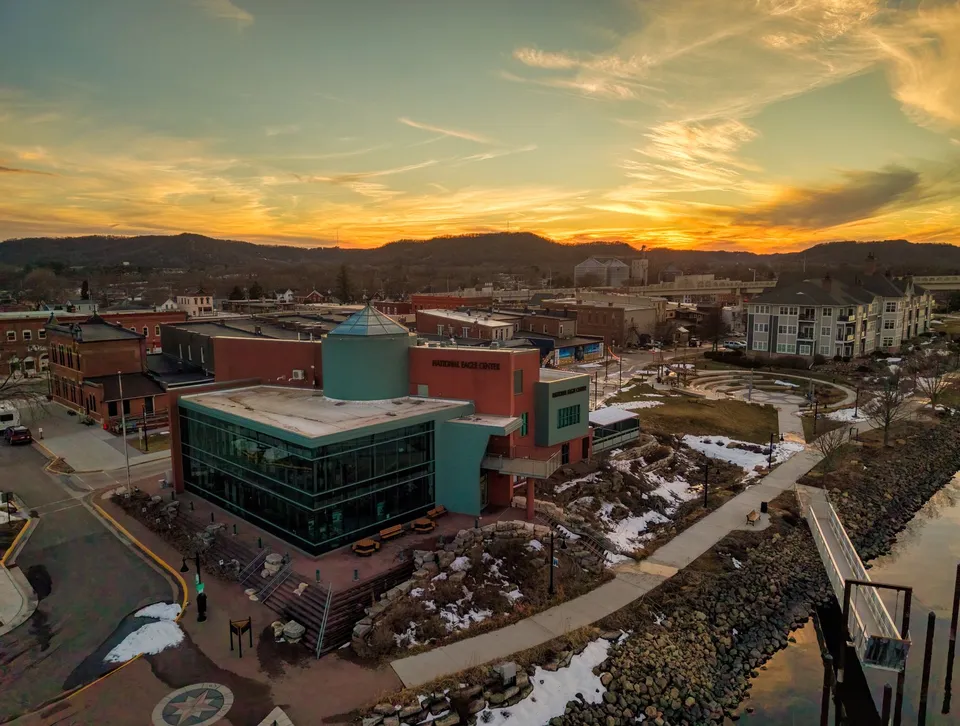
Park Rapids is easy to mistake for a simple dot on the road between lakes and forests. But the city makes more sense when you look at the places where everyday life actually happens: the river corridor at Red Bridge Park, the civic center around the courthouse, and the shared services that help people move around town and beyond it. Those three pieces show that Park Rapids is not just a scenic stop. It is a working county seat with a trailhead, a downtown, and a regional support system.
Start at the river, not the postcard
Red Bridge Park is a one-acre park, but its importance is much larger than its size. The city says the park sits on Beach Road, connects by the red bridge to Heartland Park, and serves as a trailhead for the Heartland Trail. That means the Fish Hook River corridor does more than offer a pretty view. It links walking, fishing, fireworks, and trail access in one place, which is exactly how Park Rapids often works: recreation and transportation overlap instead of staying separate.
That connection matters because the Heartland Trail is not local decoration. The county’s recreational planning materials describe it as starting in Park Rapids and extending to Cass Lake, and the chamber’s outdoor materials place the city in a larger network of scenic byways, forests, and regional trail travel. For residents, that means the riverfront is not only where people gather in summer; it is one of the ways the city plugs into the wider Heartland Lakes landscape.
Then look at the courthouse and what it represents
Park Rapids became the county seat when Hubbard County was established in 1883, and the courthouse history still shapes the city’s identity. The National Register record says county offices first operated in rented quarters, then in a county building erected by Todd Township, and later in the courthouse built in 1900 on land donated by Cyrus Hollinger. That courthouse remained the county headquarters until the mid-1970s and still stands as a major civic landmark.
That history is not just for archives. The courthouse helps explain why Park Rapids has year-round civic weight even though it is a small city. County government, local administration, and public memory all concentrate here. The Hubbard County Historical Museum at 301 Court Avenue reinforces that role, because it gives the community a place to interpret its own past instead of leaving it scattered in old files and family stories.
A steady local newspaper adds to that sense of continuity. The Minnesota Historical Society notes that the Park Rapids Enterprise began in 1882, changed names with the county in the 1880s, and later resumed publication under its original title. For a town this size, that long paper trail matters: it shows a community that has been telling its own story for generations.
The third clue is mobility
Park Rapids is not large enough for every need to stay inside one neighborhood, which is why transportation matters so much. Heartland Express says it provides safe, reliable county transportation, offers curb-to-curb bus service to Park Rapids and Bemidji, and can get riders around the city. It also works with veterans services, community education, social services, Medicaid, and other partners. That tells you mobility here is not an abstract policy issue. It is part of how people get to appointments, classes, errands, and support services.
The city airport tells a similar story. The Park Rapids Municipal Airport page says it has 44 T-hangars for rent and a second-floor terminal meeting room available by the day or half-day. That is a small detail, but it reveals something important: even a modest airport here does more than serve aircraft. It also functions as practical community infrastructure.
Why downtown still matters
Downtown Park Rapids is not just a place to pass through. Chamber materials describe it as a historic main-street district with shopping, food and beverage options, festivals, and recurring events such as the 2nd Street Stage. That makes downtown the town’s social middle, where commerce, local culture, and public gathering overlap. In a place like Park Rapids, that overlap is part of the appeal. You do not have to choose between “the practical town” and “the nice town.” The same blocks often do both jobs.
Seen together, these places explain why Park Rapids feels bigger than its population. The river corridor links people to trails. The courthouse and museum anchor civic life. The bus service and airport keep the city connected to the region. Downtown gives the whole system a place to meet. That is the real pattern: Park Rapids works because its public places are connected, not isolated.
If you want to understand Park Rapids better, spend one outing in three spots: Red Bridge Park, the courthouse area, and downtown. The route itself says a lot about how the city lives.