
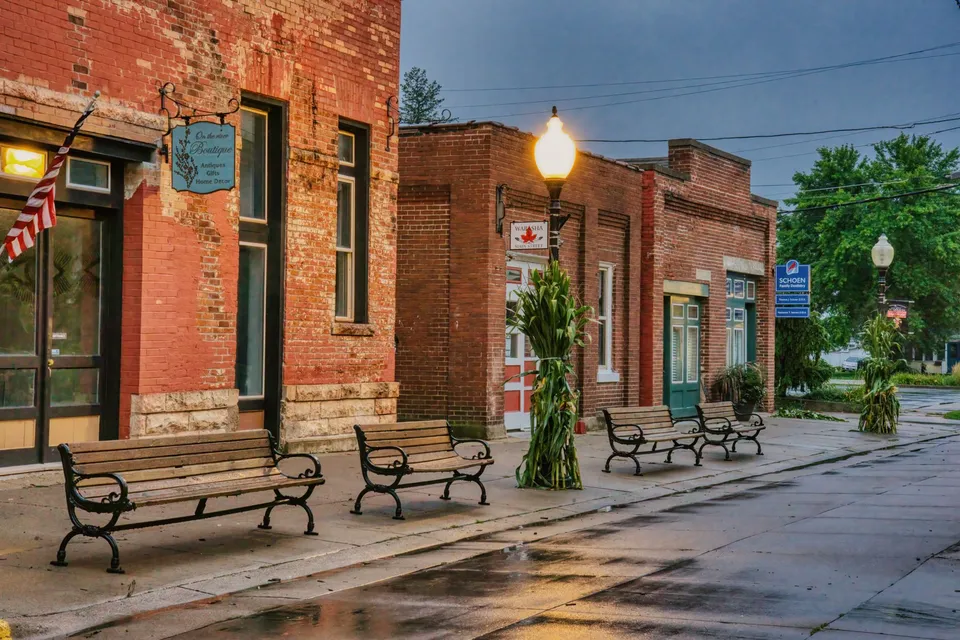
Park Rapids is easy to read as a place to pass through: county seat, lake town, trail gateway, downtown stop. But the longer you stay, the more you notice that the town also keeps a careful record of itself. In Park Rapids, history is not sealed away in one archive. It shows up in the courthouse complex, in a newspaper that has changed names and survived for generations, and in institutions that still help residents understand where they are and why the town looks the way it does. Hubbard County was established in 1883, and Park Rapids was chosen as the county seat at the first meeting of the county commissioners. The county’s courthouse followed in 1900 on land donated by Cyrus Hollinger, and the building remained the county headquarters until the mid-1970s while still occupying a prominent place in the county complex today.
That history matters because county seats shape more than government paperwork. They shape traffic patterns, public memory, and the places people instinctively use to orient themselves. Park Rapids developed in a broader northwoods story of settlement, logging, transportation, and civic consolidation. The National Register context for local historic sites places the town in the same long arc as many northern Minnesota communities: agricultural development, railroad construction, and lumbering came first, then year-round government, education, and service work became more visible. In other words, the courthouse did not just appear in a finished town; it helped turn a scattered rural region into a county with a center.
That center still has weight. Recent preservation work shows the courthouse is not a relic left to fade quietly. Minnesota Historical Society legacy materials show Hubbard County receiving funding for a roof replacement project at the historic courthouse in Park Rapids, a concrete sign that the building is still treated as an active civic asset rather than a decorative old structure. Preservation like that is easy to overlook, but it tells residents something important: the community continues to invest in the places that hold its civic memory.
A second kind of memory runs through the local press. The Minnesota Historical Society’s newspaper record shows the Park Rapids Enterprise beginning in 1882, becoming the Hubbard County Enterprise in 1883, and returning to the Park Rapids Enterprise name in 1954; it is still publishing. That continuity is unusual enough to matter. A newspaper with that kind of lifespan does more than report events. It preserves arguments, notices, celebrations, obituaries, school changes, business openings, weather problems, and the everyday details that let later generations reconstruct what life felt like here. In a town of this size, a long-running paper becomes part of the public memory infrastructure.
The value of that record is practical as well as sentimental. For newcomers, the paper helps explain how Park Rapids talks about itself. For visitors, it reveals that the town is not merely a recreation base for nearby lakes and trails. For residents, it provides a way to trace the continuity between older civic habits and present-day life. A county seat without a surviving local paper can feel thin on context. Park Rapids has both a government center and a durable news record, and together they make the town legible in a way many small places are not.
Then there is the local institution that makes history visible to people who are not professional researchers: the Hubbard County Historical Museum at 301 Court Avenue in Park Rapids. The Minnesota Historical Society directory places the museum right in town, which matters because the museum is not tucked away on the margins of county life. It sits close to the civic core, where the courthouse, downtown, and everyday errands overlap. That location reinforces the idea that memory in Park Rapids is part of ordinary public life, not a specialty reserved for historians.
The museum also reminds readers that Park Rapids’ story reaches beyond the nineteenth-century county-seat narrative. The Shell River Prehistoric Village and Mound District in Hubbard County is listed in the National Register as a prehistoric and historic-aboriginal district. That is an important corrective to any story that begins with the courthouse and stops there. The landscape around Park Rapids was meaningful long before county lines were drawn, and any honest local history has to keep that older human presence in view without collapsing modern municipal boundaries into ancient cultural geographies.
Seen together, these places explain why Park Rapids often feels sturdier than a simple resort town or a seasonal stop. The courthouse says the county needed a center. The newspaper says the town learned how to remember itself. The museum says the memory is still organized and public. And the prehistoric site says the deeper story of the land cannot begin with settlement alone. That combination gives Park Rapids a kind of depth that is easy to miss if you only know the town through a weekend drive or a single downtown visit.
For residents, this history helps explain why county government, downtown commerce, and local identity still cluster where they do. For visitors, it offers a better way to spend an hour than simply passing through: look at the courthouse area, notice the long-running newspaper tradition, and step into the museum if it is open. For newcomers, it is a reminder that Park Rapids is not just a pin on the map but a place with institutions that have outlived several versions of the town around them. If you want a simple next step, start at the Hubbard County Historical Museum on Court Avenue and then walk toward the courthouse square. You will see how much of Park Rapids is still organized around the places that taught it how to remember.