
Park Rapids can look compact on a map, but daily life says otherwise. The town carries the responsibilities of a county seat, keeps a municipal airport active, connects to county transit, and maintains parks and utility systems that serve residents year-round. Hubbard County had 21,344 people in the 2020 census and an estimated 22,369 in July 2025, yet the local footprint includes civic buildings, trail access, downtown businesses, and regional services that make the place feel more connected than its population suggests. The county’s emergency planning also reaches beyond Park Rapids into Akeley, Laporte, and Nevis, which is another reminder that the Heartland Lakes area works as a network, not as one isolated town.
A county seat that never stopped being one
Park Rapids became the county seat when Hubbard County was established in 1883, and that choice still shapes the town’s identity. The county offices first operated in rented quarters, then in a county building erected by Todd Township, and later in the courthouse built in 1900 on land donated by Cyrus Hollinger. That building still anchors the civic center today, which matters because it shows how much of Park Rapids’ public life has been built around steady institutions rather than one-time growth spurts. The Park Rapids Enterprise adds another layer of continuity: the paper began in 1882, changed names with county history, resumed publication as the Park Rapids Enterprise in 1954, and is still publishing. Add the Hubbard County Historical Museum at 301 Court Avenue, and Park Rapids reads less like a vacation stop and more like a place that has kept its own records for generations.
The river corridor is a route, not just a view
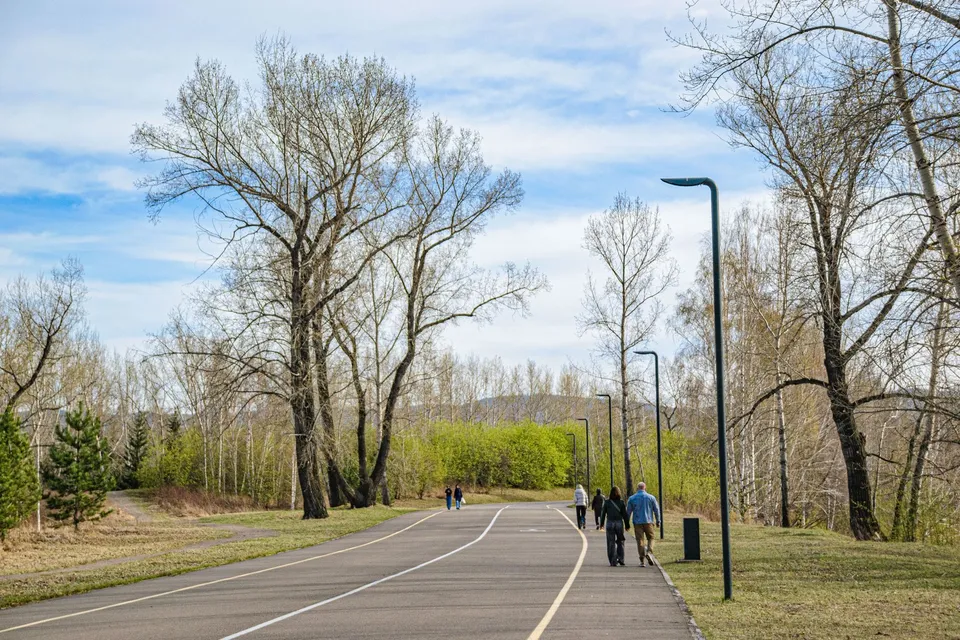
One of the clearest examples of Park Rapids’ practical geography is Red Bridge Park. The city says the park sits on Beach Road, covers one acre, connects by the red bridge to Heartland Park, and serves as a trailhead for the Heartland Trail. That means the Fish Hook River corridor is not just scenery; it is one of the ways people move through town. It is where a person can fish, walk, watch fireworks, or step onto the trail system without needing to drive across a larger metro-style park network. The Heartland Trail itself starts in Park Rapids and runs to Cass Lake, so the city is not merely adjacent to recreation country. It is one of the nodes that makes that region work.
The systems people notice only when they fail
The less visible infrastructure in Park Rapids may be the most important. Heartland Express says it provides curb-to-curb transportation for Hubbard County residents, offers bus service to Park Rapids and Bemidji, and can get riders around the City of Park Rapids. It also works with veterans services, community education, the Development Achievement Center, social services, Medicaid, and other partners. That makes mobility part of the support system, not an afterthought, even if riders still have to check schedules and coverage before counting on a trip for work or an appointment. The city airport plays a similar role at a smaller scale: the airport page says 44 T-hangars are available for rent, and the terminal includes a second-floor meeting room available for community use. Park Rapids also maintains the plumbing of ordinary life in a very literal way, with 1,370 water connections, 1,270 sewer connections, two water towers, five wells, and 16 lift stations. Those numbers are not glamorous, but they explain how a small city can still support a broad range of daily needs.
Why the local economy feels mixed instead of one-note
Hubbard County’s economy is broader than resort traffic or one busy summer season. The research base shows 630 employer establishments, 4,685 total employment, 1,771 nonemployer establishments, and $336.154 million in retail sales in 2022. That is the profile of a county with many small businesses, a meaningful base of self-employed operators, and enough retail activity to support day-to-day life for residents, visitors, and nearby township households. The population profile reinforces that mix: 83.1% of housing units are owner-occupied, 28.5% of residents are age 65 and over, and 20.1% are under 18. In other words, Park Rapids serves older adults, families, and working households at the same time. The Park Rapids Area Schools district reflects that reality by offering job-shadow opportunities, finance classes, the ASVAB, interest assessments, and tools like CAREERwise and YouScience. The school district is not just preparing students for somewhere else; it is helping build the local pipeline that the area depends on.
What newcomers and longtime residents both need to know
If you are deciding where to live, work, or open something small, Park Rapids makes more sense when you think in systems rather than single addresses. The city’s rental pages show that housing is regulated through rental licenses, inspection checklists, safety guidelines, and short-term rental forms. The planning FAQ says a development plan review usually takes about 60 to 90 days, while home occupations often take 30 to 60 days to review. Those details matter for anyone considering a move, a remodel, or a home-based business, because local timing is part of the real cost of setting up life here. Downtown remains the social center, with the chamber promoting shopping, festivals, food and beverage options, and recurring events such as the 2nd Street Stage. But the broader Heartland Lakes region stretches through nearby communities such as Nevis, Akeley, and Laporte as well as Park Rapids itself. That is why a grocery run, a commute, or a housing decision often depends on more than one town.
The real takeaway
Park Rapids feels larger than its population because it has to. It is the administrative center of Hubbard County, a trail gateway, a transit node, a small airport town, and a place where utilities and community institutions do the uncelebrated work of keeping a rural region livable. The fact that these systems are spread across city offices, county services, schools, and nearby communities is not a weakness; it is the reason the area keeps working. If you want to understand Park Rapids quickly, start with one loop through downtown, one stop at Red Bridge Park, and one look at how the city and county organize everyday services.