
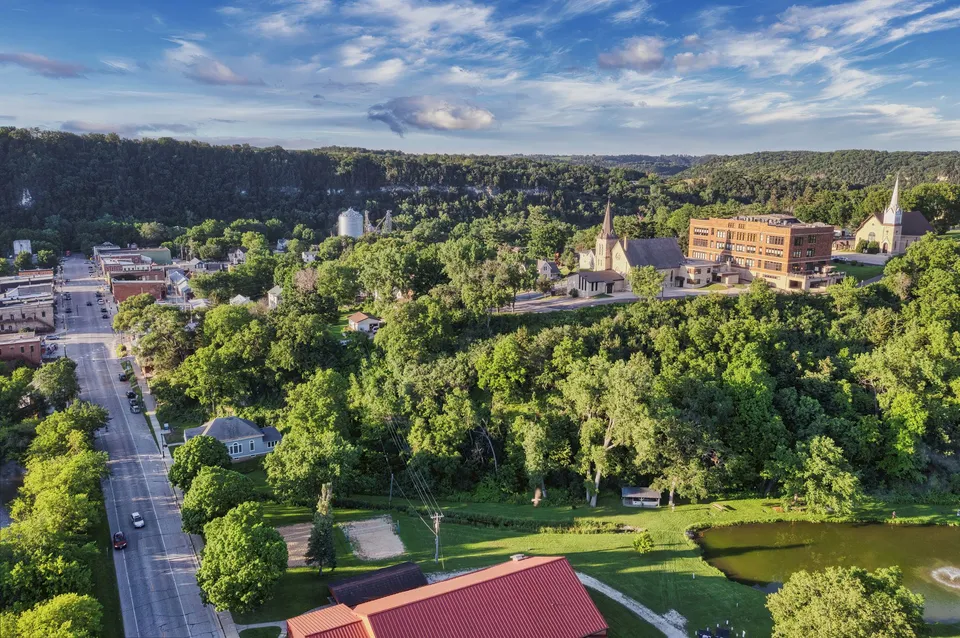
Red Bridge Park is only one acre, but in Park Rapids that small footprint carries an outsized job. The city says the park sits on Beach Road, connects by the red bridge to Heartland Park, and serves as a trailhead for the Heartland Trail. In other words, it is not just a green space; it is a crossing, a starting point, and a place where the river edge turns into everyday movement. That is a useful clue to how Park Rapids works as a town: recreation, downtown life, and local travel all overlap instead of staying in separate boxes.
That overlap matters because Park Rapids sits inside a larger Heartland Lakes network, not a sealed-off city block. Hubbard County’s map includes Park Rapids, Akeley, Laporte, and Nevis among its incorporated places, while county parks maintain public boat accesses and beaches at places such as Stony Lake, the Fish Hook River at Heartland Park, Garfield Lake near Laporte, and Lake George Community Park. So when residents talk about “going out” for the afternoon, they may be talking about a river walk in town, a county beach, or a lake access a few miles away. The geography is linked, and the parks system is built to match it.
A small park with a big job
Red Bridge Park works because it connects uses that Park Rapids already values. The city’s parks page shows it linking directly to Heartland Park, and the trailhead connection makes it part of the broader trail system rather than a dead-end picnic spot. The Heartland Trail itself starts in Park Rapids and runs all the way to Cass Lake, which helps explain why this little river crossing feels larger than its size. It is one of the places where a resident can move from downtown rhythms to trail use without feeling like they left town behind.
That matters in a community where downtown is still a real social center, not just a place to pass through. The Chamber promotes downtown shopping, food and beverage options, festivals, and recurring programming such as the 2nd Street Stage. The point is not that every outing has to become an event; it is that Park Rapids has preserved a walkable main-street feel that still supports everyday errands, meetups, and local celebrations. When a town has both a trailhead and a downtown that people use on purpose, the spaces reinforce each other.
Why the river corridor feels so central
The Fish Hook River is one reason the connection works. Red Bridge Park sits on the river edge, and Heartland Park adds another layer of access and gathering space on the other side. That arrangement makes the corridor useful for more than scenery. People fish, walk, watch fireworks, and enter the trail system there, which gives the area a practical role in the town’s seasonal rhythm. In Park Rapids, “going to the park” often means choosing how you want to use the river: as a crossing, a fishing spot, a trail entrance, or a place to pause.
Transportation helps keep that local geography open to more people. Heartland Express says it provides curb-to-curb bus service to Park Rapids and Bemidji, and that it can get riders around the City of Park Rapids. It also works with Veterans Services, Community Education, Social Services, Medicaid, and other partners. That is a practical mobility network for a county where not every errand, appointment, or shift is on the same block. Even for a park-and-trail story, transit matters because it determines who can actually use the places the city and county maintain.
The older civic layer underneath the scenery
Park Rapids is also the Hubbard County seat, which gives the town a civic weight that goes beyond recreation. The county was established in 1883, and the first county commissioners chose Park Rapids as the seat at their first meeting. Historic records also show the county courthouse evolving from rented quarters to a dedicated building and then to the courthouse built in 1900, which still anchors county identity. That history helps explain why Park Rapids feels like a working center, not only a visitor base. Government, parks, roads, and downtown all grew together.
That long memory shows up in local institutions too. The Park Rapids Enterprise has a publication history stretching back to 1882, with a continuity that gives the community an unusually durable public record. For a small county seat, that kind of memory matters: it keeps local debates, celebrations, and civic changes from feeling anonymous. A town that can point to its courthouse, its newspaper, and its trailhead is a town that knows how to explain itself.
If you want to understand Park Rapids quickly, start at Red Bridge Park and look both directions. One way leads into the Heartland Trail. The other leads back toward downtown, where the town’s events, businesses, and civic life keep the river corridor from feeling like the edge of town.